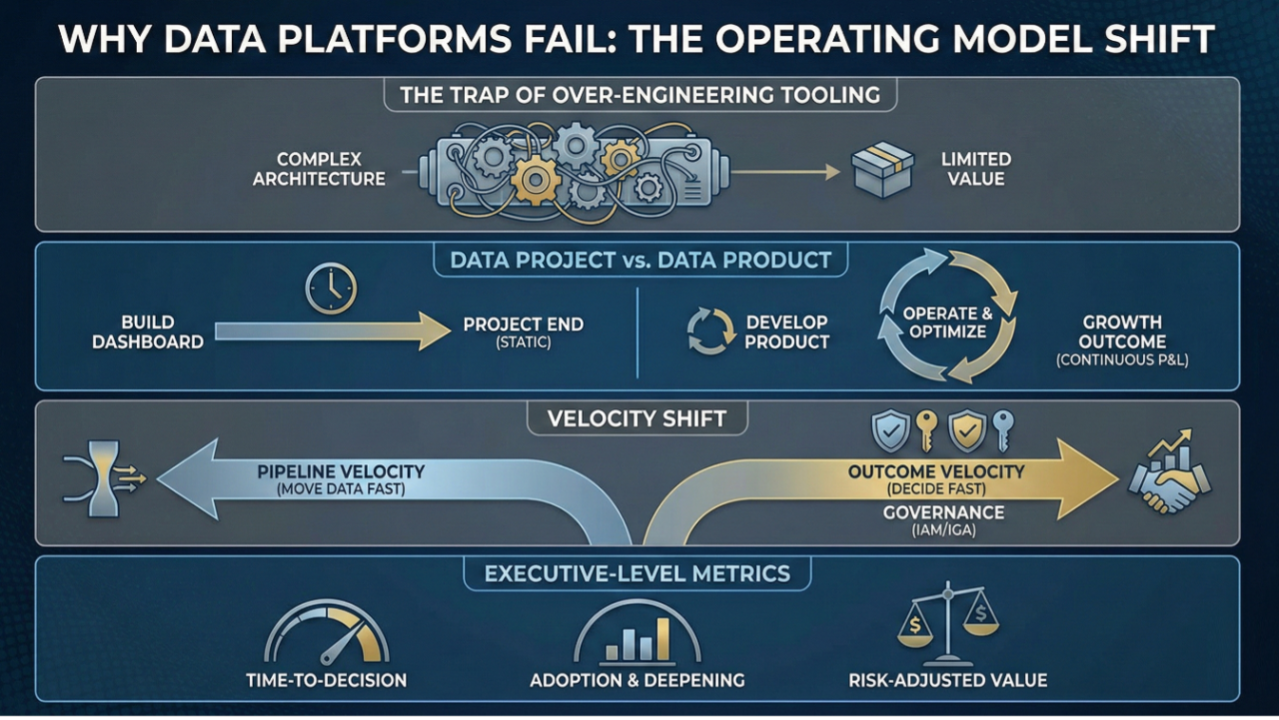
We have entered a transformative era defined by the decline of the monolithic “all-in-one” solution. Modern organizations are deserting their pursuit of the single silver bullet, in favor of specialized agile ecosystems that are designed to democratize usage, promote nimbleness for business growth, and reduce operational friction at its source. The first quarter of 2026 is already behind us. As we progress through the rest of the year, the conversation around data architecture is maturing in powerful ways. Companies seeing real commercial lift from their data are the ones embracing the shift toward modularity and adopting a truly Composable Data Stack. It’s a strategic evolution that’s unlocking speed, flexibility, and measurable enterprise value.
It is about building ecosystems that proactively enable growth and innovation. By focusing on capability models rather than just technical infrastructure, data leaders are driving continuous P&L impact and accelerating go-to-market (GTM) performance.
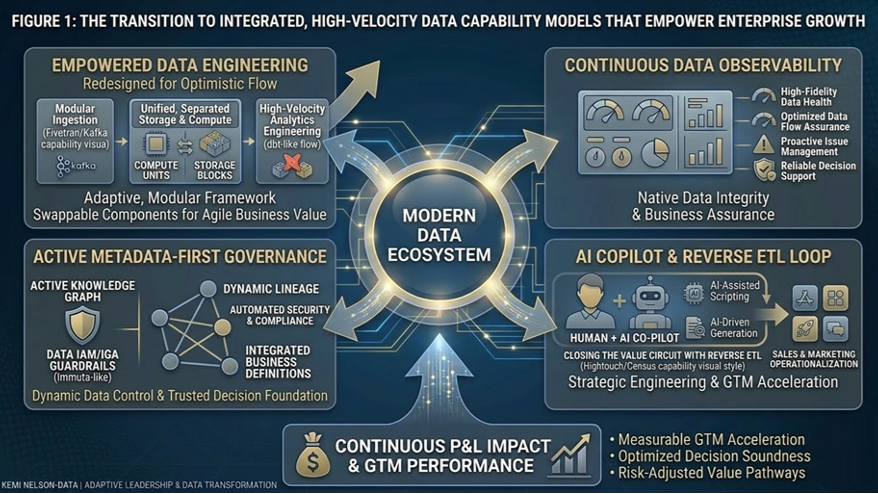
- Composable Architectures & Separation of Compute/Storage: We now have the freedom to build beyond rigid, single-vendor ecosystems. By leveraging modular components — like high-fidelity ingestion via Fivetran or Kafka, a unified compute/storage layer in Snowflake or Databricks, and dbt for robust analytics engineering — we can perfectly tailor our environments. This composable capability model allows us to seamlessly adapt and swap components, ensuring the platform remains a dynamic engine for business value.
- Metadata-First Ecosystems: Data becomes a true asset when enriched with context. Today’s leading platforms treat metadata as an active, foundational layer. Rather than static catalogs, we are building dynamic knowledge graphs with illuminated data lineage, business definitions, and automated security controls. By embedding sophisticated access and governance (like Data IAM and IGA via tools such as DataHub, Collibra, or Immuta) directly into the workflow, we empower business leaders to sit at the decision table with complete confidence in the source data of their profitability and pricing metrics.
- Embedded Data Observability: Trust is the currency of effective data product models. Observability is now a native, proactive feature rather than a reactive afterthought. We are elevating pipeline reliability, data health, and functional soundness – using active monitoring platforms like Monte Carlo or Bigeye – with the same rigor we apply to critical application uptime. This automated visibility actively builds trust, ensuring our decision systems are consistently sound and ready for action.
- AI-Assisted Data Engineering: AI is brilliantly accelerating how we build, unlocking new levels of innovation. Copilots are taking on rote data ingestion scripting, complex SQL generation, and automated pipeline documentation. By liberating our data engineers from repetitive tasks, AI elevates them into true strategic growth partners. They can now focus on designing high-impact value pathways, such as closing the loop with Reverse ETL (via Hightouch or Census) to operationalize data directly into sales and marketing ecosystems. It is transforming the “how”, not the “what”, because we still need a human-in-the-loop to vet and refine. *spoiler alert – no, AI is not taking away all jobs.
The bottom line: Modern data tooling presents an incredible opportunity to architect resilient, adaptable capability models that translate raw technical potential into continuous enterprise value. It is about building ecosystems that proactively enable growth and innovation. By focusing on capability models rather than just technical infrastructure, data leaders are driving continuous P&L impact and accelerating go-to-market (GTM) performance.
As I continue to bridge my doctoral research in Adaptive Leadership with the realities of enterprise data transformation, it’s clearer than ever: when our tools adapt to our people and our holistic problem-solving needs, the possibilities are boundless. If these topics interest you, chime in below in the comments, follow along, and/or reach out to continue the conversation.