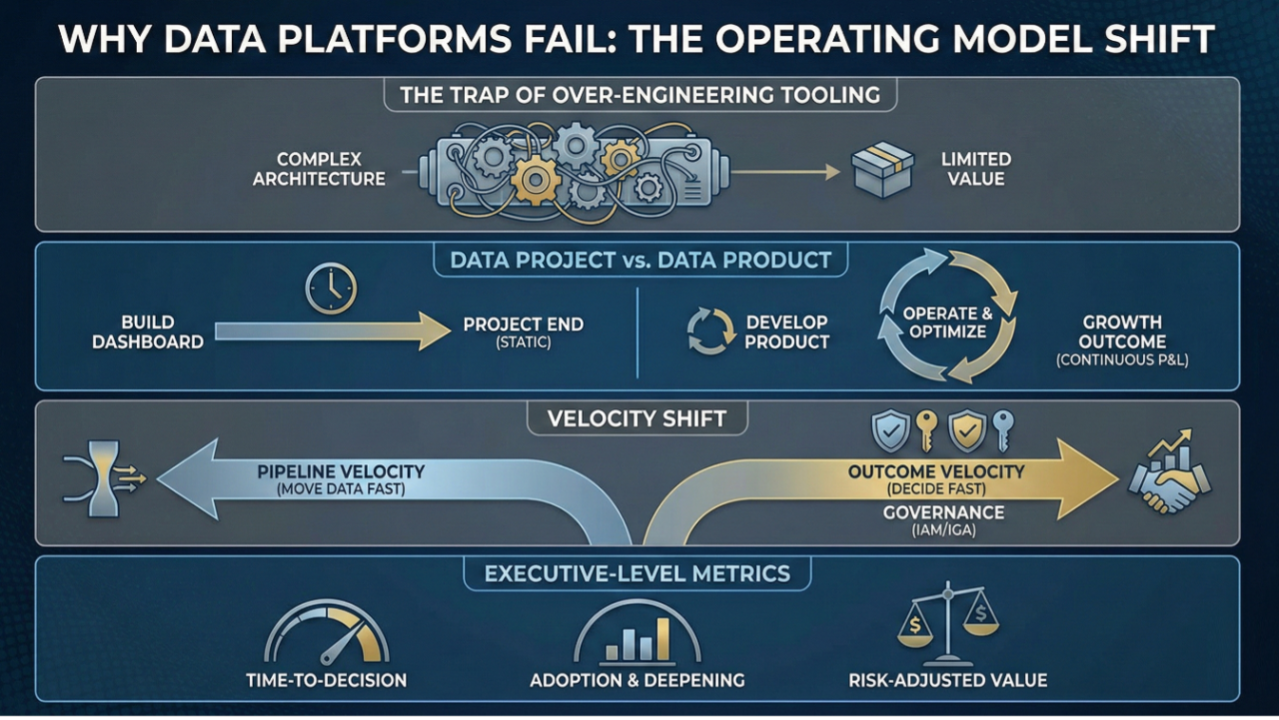
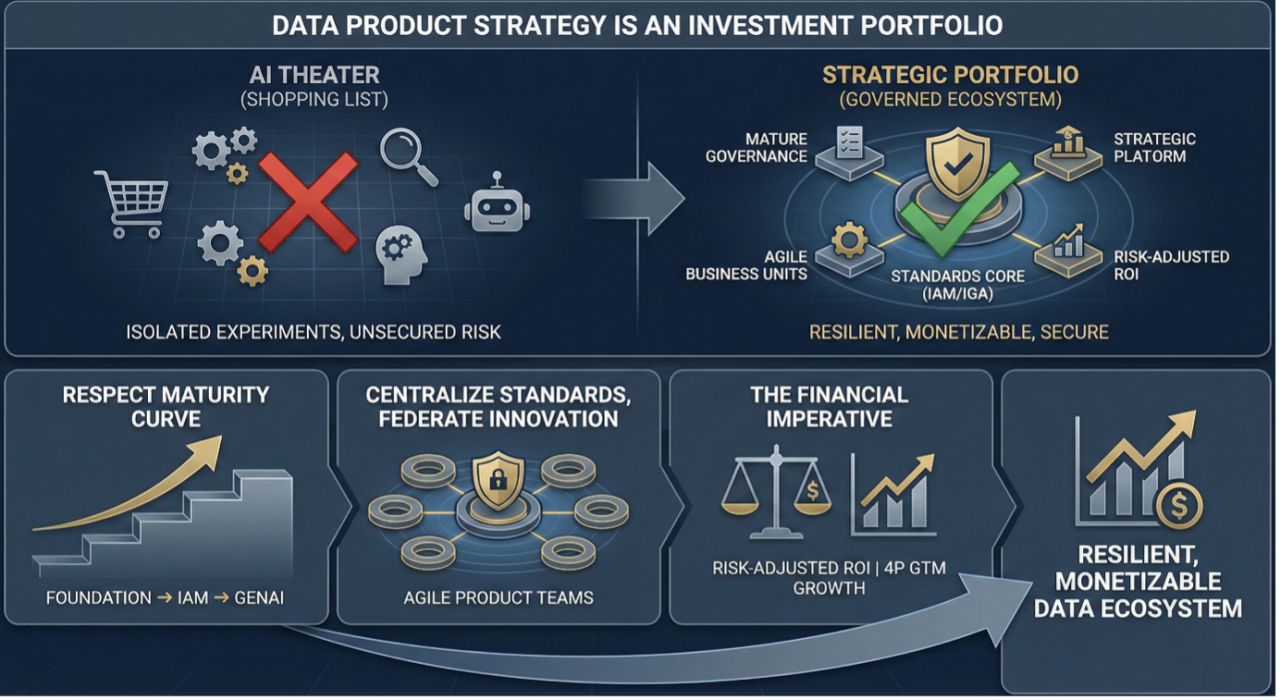
High‑performing organizations treat their data ecosystem like an investment portfolio. Low performing organizations treat theirs as a collection of disjointed tools, product pilots, and experiments. When you shift into Portfolio thinking – beyond Portfolio simply as an Agile concept – you move from scattered activity to a governed, strategic system that compounds value over time and directly supports robust AI enablement with clear impact to the organization’s bottom line.
“AI Theater” is an illusion of innovation that produces limited to no organizational equity. It is often due to an attraction to AI as the new flavor, without much thought to driving the organization’s AI strategy through the lens of a future-proofed ecosystem. A sound portfolio strategy rests on three anchors: respecting the maturity curve, centralizing standards to unlock federated innovation, and managing to financial ROI instead of technical vanity metrics.
1. Respect the Maturity Curve
Data democratization only works when governance maturity supports it. Sequencing matters. Advancing into GenAI without foundational data readiness doesn’t accelerate innovation—it accelerates risk. A portfolio lens guides leaders to invest in the right order and confidently avoid the allure of jumping on board an exciting order without deep contemplation. However, when that readiness is in place (and this can be quickly achieved), then investments in Gen AI very quickly reap business dividends that are measurable and impactful.
2. Centralized Standards, Federated Innovation
The strongest ecosystems balance central guardrails with decentralized value creation.
Centralized engineering and governance standards protect the enterprise.
Federated product teams innovate at the speed of their P&L.
This structure keeps the enterprise ecosystem coherent while ensuring that innovation stays close to the business and doesn’t get slowed down by bureaucracy or disconnected architectural preferences.
3. The Financial Imperative
The most meaningful conversations about data platforms center on Risk‑Adjusted ROI, not pipeline latency or ingestion rates.
A data product earns its place in the portfolio by:
– accelerating growth
– optimizing cost
– mitigating risk
– driving measurable 4P GTM impact
If a data strategy can’t be tied to the balance sheet, it may inadvertently just be a corporate hobby. Portfolio discipline ends the subsidization of isolated experiments and builds a resilient, monetizable data ecosystem.
A question for fellow tech leaders: How are you prioritizing your data investments so far in 2026, and what financial business targets are directly tied to the products you’re funding this year?