
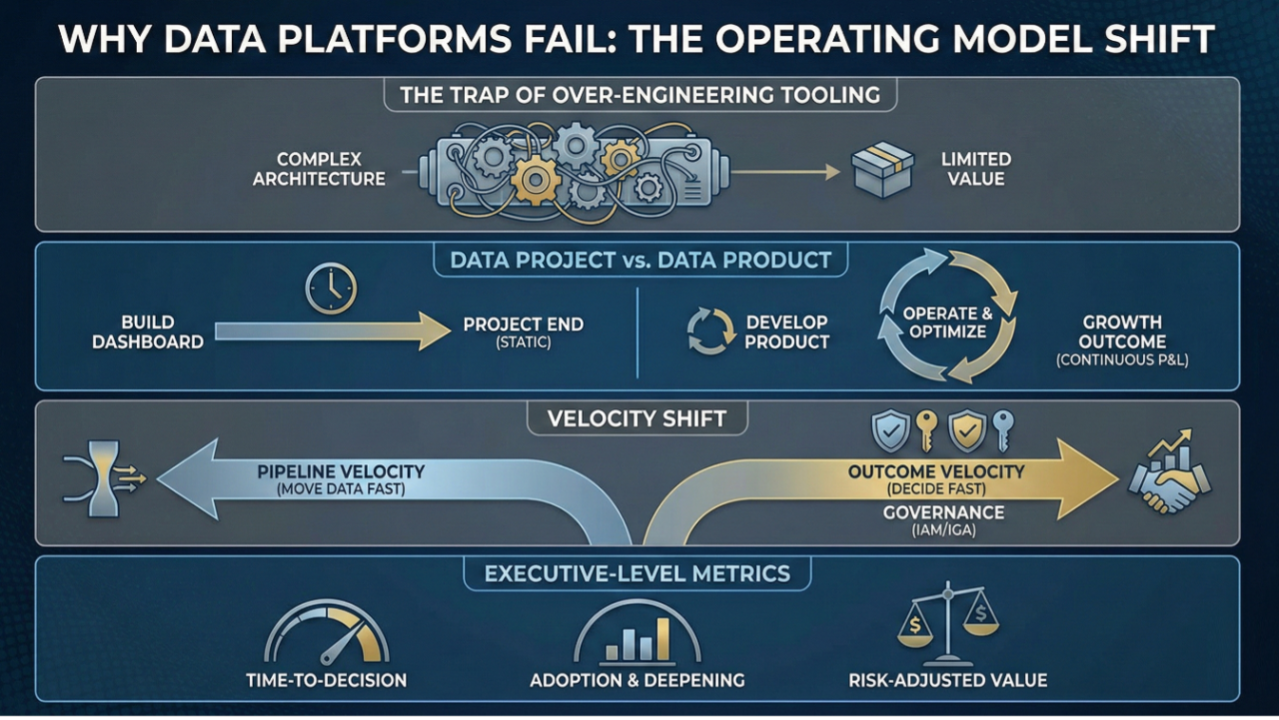
We’re getting deep into the era of GenAI, and the pressure to modernize data capabilities has never been higher. Yet across industries, a familiar pattern keeps repeating: organizations invest heavily in sophisticated architectures, only to see limited business value materialize. The instinct is to blame the tech stack. In reality, the breakdown often lives in the operating model – the human, organizational, and decision‑making systems that determine whether technology can actually create value.
To shift this pattern, leaders must rethink four core assumptions: (i) stop over‑engineering architectures, (ii) move from project outputs to continuous value assets, (iii) prioritize outcome velocity over pipeline velocity, and (iv) anchor progress to executive‑level metrics that matter.
The organizations that win in the GenAI era will be the ones that treat operating models and adaptive problem solving — not tooling — as the true engine of value.
1. The Trap of Over‑Engineering Tooling
Modern data ecosystems matter, but complexity for its own sake does not. When teams build expansive data lakes and ML Ops pipelines without a clear line of sight to business friction, the platform becomes a cost center instead of a growth engine.
A sustainable architecture should be nimble, value‑linked to the business, and directly leverage on patterns that matter for business patterns – resisting the temptation to build as a monument to technical possibility.
2. Data Value Mindset vs. Data Projects
A data project delivers a static output, such as a dashboard, and calls that the endpoint. A data value mindset treats data as a living asset with a lifecycle, P&L impact, and measurable contribution to go-to-market (GTM) performance.
This shift elevates engineering and analytics teams from ticket‑takers to strategic growth partners. It also helps organizations to think in terms of continuous ROI, not one‑and‑done deliverables and puts data at the head of the decision table, having gained that credibility.
3. From Pipeline Velocity to Outcome Velocity
For years, enterprises measured success by how fast data moved from point A to point B. But pipeline velocity is irrelevant if it doesn’t accelerate decision‑making — and accelerate it safely.
Outcome velocity requires:
- measuring decision acceleration, not just data movement
- treating governance as an enabler of speed, not a constraint
- embedding data standards and security controls, such as basic IAM/IGA directly into the platform as business enablers
if done right, good governance should not be bureaucracy. It is a viable mechanism for rapid, responsible, and relevant delivery.
4. Executive‑Level Metrics That Command Alignment
A robust operating model connects platform performance to metrics that resonate in the boardroom:
- Time‑to‑Decision — how quickly data enables financially sound pivots
- Adoption — the degree to which business teams actually embrace and use data delivery outputs – like models, insights, and profitability & pricing tools – to drive business growth
- Risk‑Adjusted Value — whether revenue and functional excellence outweigh infrastructure and governance costs beyond the quarterly P&L.
These metrics drive clarity: is the platform accelerating the business, or simply generating activity?
The bottom line: Data platforms rarely fail because the technology is flawed. They often fail when leadership, operating models, and value pathways aren’t adaptively designed to translate technical capability into enterprise outcomes that index to holistic problem solving. The organizations that win in the GenAI era will be the ones that treat operating models and adaptive problem solving — not tooling — as the true engine of value.
As I approach a year since completing my doctoral study in Adaptive Leadership for Enhancing Strategy Transformation in Data & Technology, I’m continuing to explore how operating models – not tech alone – shape real lasting enterprise value. If these themes resonate for you, follow along, share your take in the comments, and/or reach out to continue the conversation.