AI has officially secured the boardroom’s full attention, presenting us with an unprecedented opportunity to drive real transformation. While output accuracy is non-negotiable, an over-fixation on hallucinations distracts us from the deeper structural and operational shifts that actually scale enterprise value. When leaders widen the lens beyond tactical generative errors alone, they create the conditions for stronger operating models, smarter governance, and AI that truly accelerates the business.
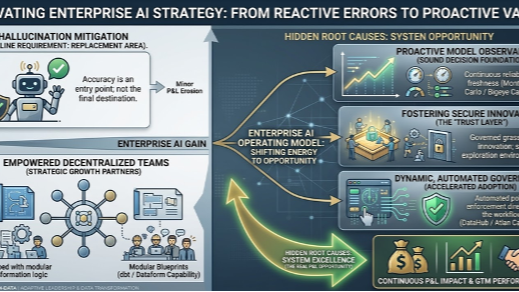
To build ecosystems that sustainably scale, the most forward-thinking organizations are shifting their energy toward four critical capability areas:
- Dynamic, Automated Governance: We now have the tools to govern 2026 capabilities with equally advanced 2026 policies. By adopting an Active Metadata Control Plane — using platforms like DataHub, Collibra, or Atlan — we embed dynamic lineage, data discovery, and automated policy enforcement directly into the workflow. This transforms governance from a static bottleneck into an automated guardrail that actively accelerates safe, responsible AI adoption.
- Fostering Secure Innovation: Agile business units naturally want to move fast to solve problems. Rather than viewing unsanctioned “Shadow AI” purely as a threat, successful operating models proactively provide an accessible, secure “Trust Layer” internally. By giving teams safe, governed environments to explore AI, we turn potential compliance risks into engines for grassroots innovation.
- Proactive Model Observability: A pricing or risk model is only as smart as the current market context. Instead of waiting for models to drift, leaders are proactively embedding continuous reliability and freshness monitoring (leveraging capabilities from platforms like Monte Carlo or Bigeye). This stance ensures that the models driving our execution layers remain highly accurate, consistently delivering financially sound decisions.
When leaders widen the lens beyond tactical generative errors alone, they create the conditions for stronger operating models, smarter governance, and AI that truly accelerates the business.
- Empowering Decentralized Teams: By intentionally moving away from rigid centralization, we unlock tremendous value creation. Equipping decentralized teams with modular transformation logic (like dbt or Dataform) elevates data engineers from a queue of ticket-takers into strategic growth partners. This structural freedom empowers them to work directly alongside the business to drive 4P GTM outcomes.
The bottom line: The most impactful corporate AI operates within a resilient, value-linked operating model. When we shift our energy from merely reacting to output errors to actively architecting for sustainable, governed adaptability, we unlock the true commercial promise of these technologies.
Through my ongoing work applying Adaptive Leadership to AI transformation, it is abundantly clear that capturing this opportunity requires a cultural evolution just as much as a technical one. When we build ecosystems that empower our people and adapt to our business realities, the results speak for themselves.
I’m enjoying the intellectual dialogues with many of you via email and private messaging, thank you. If your organization is successfully navigating this exciting balance between AI innovation and functional soundness, follow along, share your take in the comments, and/or reach out to continue the conversation.